 |
|

|
|
|
|
|

|




|
|||||||


|
Reviews
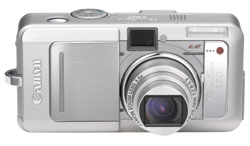
Canon PowerShot S60 I must confess that the 10D has spoiled me. The ability to use interchangeable lenses as well as its performance at high ISO settings impressed me from the start. The prints from my 10D have always been quite satisfying, easily matching what I was getting from scanning 35mm fine-grained slide film. Could Canonâs new PowerShot camera impress me as much as their best-selling digital SLR camera? When the camera arrived, I was eager to give it a spin. I pulled it out of the box and was impressed by its size and weight. Itâs just right for a point and shoot camera and feels solid and comfortable in my hands. The S60 has a protective metal shell and weighs a mere 8.11 ounces without a battery. Setup was easy. I took a quick peek at the manual to make sure I was charging the battery correctly. Once that was done, I set the well-written, 173-page manual aside. The battery charger has no power cord; it plugs directly into an AC outlet and took a little over an hour to charge. I found the cameraâs controls to be well laid out and intuitive, with very few functions that I couldnât figure out on my own.
If the 100mm lens doesnât have enough reach for you, Canon makes a telephoto lens attachment that doubles that to 200mm. It requires an adapter that also enables the camera to accept 37mm screw-in filter attachments. The LCD viewfinder is bright and easy to see, and contains approximately 118,000 pixels, covering 100% of your subject. Thereâs also an optical viewfinder that covers 80% of the subject area. The optical viewfinder has no diopter adjustment.
Thereâs a great Macro mode for taking close-up shots, allowing the user to focus on a subject as close as 1.6 inches from the lens. Canon cautions that flash coverage might be erratic with a subject thatâs too close, however. I was pleasantly surprised when I set the camera to ISO 50 and closely examined the results. Noise was all but absent at this setting and the images this camera produces are rich, saturated and noise-free at ISO 50. The noise isnât terribly bad at ISO 100, but when cranked up to ISO 200, itâs worse, and when the camera is set to itâs highest setting of ISO 400, itâs very evident.
The S60 has the usual ãcannedä or ãImage Zoneä modes such as portrait and landscape for beginners as well as a ãStitch Assistä mode for help with creating panoramic shots. Four manual or ãproä exposure modes are also available: Program AE, which is the automated choice; Shutter Priority, Aperture Priority and Manual control are available too. The camera offers exposure compensation in 1/3rd stop increments for +/- two stops and also supports Auto Exposure Bracketing. The S60 can even bracket your focus too, which only works when youâve selected these ãproä modes. Thereâs also a Custom mode on the control dial, which can be used to store one of your favorite combination of settings. Fortunately for us ãpixel peepers,ä this new Powershot offers a histogram feature to confirm good exposure. Unfortunately it takes a few steps to see it; having the histogram appear along side the preview image would be a nice touch. White balance can be selected via the function menu. In very tricky, mixed-lighting situations a custom white balance can be set manually with a white or gray card. Canon has even included a special white balance setting for underwater photography and sells a waterproof housing for this camera.
While itâs unlikely that Steven Spielberg will be using this camera to film his next epic, the movie mode is still a fun feature to have. Each clip is limited to three minutes so as not to consume too much storage space. Audio recordings can be made up to 1 minute long and are stored along with your image data in a .WAV format. The ãPhoto Effectsä settings include Vivid, Neutral, Low Sharpening, Sepia, B&W and Custom. Fast shooting isnât a problem with the S60. I did not find shutter lag to be a problem either and the camera usually locks focus in about 1/2 second. In Standard Continuous Mode the S60 can capture seven shots at about 1.3 frames per second. The next choice is High Speed Continuous and if you select this mode you cannot check your images while shooting, but the camera can zip along, shooting about 2 frames per second. The S60 also includes a self-timer, and thereâs even an ãIntervalometerä which allows you take pictures in timed intervals. RAW mode is supported too and it has many advantages, as well as a few disadvantages. If you have the storage space and an important shot to capture, then you might want to take a closer look at the RAW format. Canon bundles its own excellent RAW converter (File Viewer Utility) along with its USB downloading program, Zoom Browser, Remote Capture Software and Arcsoft Camera Suite.
There were many things about the Canon PowerShot S60 that I liked very much and even though this camera was never intended to compete with its digital SLR cousins, thereâs one area that it did: The lack of noise in my prints when shot at ISO 50. The S60 delivers excellent image quality when used at ISO 50 and beautiful prints can be made quite a bit larger than the norm of 8 by 10 inches. The autofocus assist lamp does an admirable job in low-light photography but I still found myself using manual focus quite a bit. Even though it uses proprietary batteries, each charge left me able to shoot almost all day. If you have a favorite setting, it can be stored and recalled instantly with the Custom feature on the mode dial. Whatâs not to like? The 32Mb CF card Canon included means youâll need to buy more storage. The S60 can use any Type I or II CF card or an IBM/Hitachi Microdrive so be prepared to spend a little more on storage. I found I could delete one image, or all of the images, but I couldnât select, say five or six images and delete only them. Other minor gripes include a small amount of ãpurple fringingä that can show up in some images, and it does take some fumbling to display the histogram for each shot. Iâm also not a huge fan of the door that doubles as an on/off switch, although I must admit this does a good job of protecting the lens. All in all, Canon has another winner on their hands. If you need a feature-packed digital camera that is capable of excellent image quality, fits in your shirt pocket and is a joy to use, look no further than the Canon Powershot S60. öBeau Hooker
|
||||||
|
|
|||||||
|
©
2004 D.C. Publications, Inc. All Rights Reserved. |
|||||||
 For
over a year now Iâve been lugging around my Canon 10D digital camera
with a heavy telephoto lens and second battery attached. I often
felt like Quasimodo by dayâs end. Iâd forgotten the joys of having
a nice point and shoot camera that fits comfortably in my shirt
pocket. Canon reminded me what Iâve been missing when they sent
me the PowerShot S60 digital camera.
For
over a year now Iâve been lugging around my Canon 10D digital camera
with a heavy telephoto lens and second battery attached. I often
felt like Quasimodo by dayâs end. Iâd forgotten the joys of having
a nice point and shoot camera that fits comfortably in my shirt
pocket. Canon reminded me what Iâve been missing when they sent
me the PowerShot S60 digital camera. 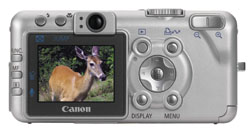 The
S60 is effectively a 5 megapixel camera, and uses a 1/1.8 CCD image
sensor. The lens is a 28-100mm (35mm equivalent), which is wider
than most. A nine-point autofocus system is aided by the cameraâs
focus assist beam. Focus points can be tied to the spot meter for
accurate exposure and can be selected using the Set button. The
S60 does have a ãdigital zoomä feature which Canon has wisely left
off by default.
The
S60 is effectively a 5 megapixel camera, and uses a 1/1.8 CCD image
sensor. The lens is a 28-100mm (35mm equivalent), which is wider
than most. A nine-point autofocus system is aided by the cameraâs
focus assist beam. Focus points can be tied to the spot meter for
accurate exposure and can be selected using the Set button. The
S60 does have a ãdigital zoomä feature which Canon has wisely left
off by default.  The
S60âs lens is a new design that has allowed Canon to make the camera
smaller than its predecessor. Aperture range is f/2.8 to f/8 depending
on focal length and shutter speeds can be selected between 15 seconds
and 1/2000th of a second. As with most ãprosumerä digital cameras,
this lens is very good but not great. I noticed a small amount of
distortion and chromatic aberration in some of my image tests.
The
S60âs lens is a new design that has allowed Canon to make the camera
smaller than its predecessor. Aperture range is f/2.8 to f/8 depending
on focal length and shutter speeds can be selected between 15 seconds
and 1/2000th of a second. As with most ãprosumerä digital cameras,
this lens is very good but not great. I noticed a small amount of
distortion and chromatic aberration in some of my image tests.  There
are three metering modes, Evaluative, Center-weighted and Spot.
Evaluative is probably the one most commonly used and it works well.
The Center-Weighted mode is useful in tricky lighting situations
and the Spot mode will meter a very small area linked to the selected
focus point of the camera. By default this point is the center of
the frame, but thatâs easily changed so that an off-center focus
point can be used.
There
are three metering modes, Evaluative, Center-weighted and Spot.
Evaluative is probably the one most commonly used and it works well.
The Center-Weighted mode is useful in tricky lighting situations
and the Spot mode will meter a very small area linked to the selected
focus point of the camera. By default this point is the center of
the frame, but thatâs easily changed so that an off-center focus
point can be used.  The
built-in flash works well from anywhere from 6 to 14 feet from the
subject. External flash is not supported and there is no hot-shoe.
The Red-eye reduction feature is there, which is a good thing due
to the close proximity of the flash to the lens. Canon lists a conservative
10 second recycle time between flashes, and just like exposure compensation,
Flash Exposure Compensation is supported too. There are also some
advanced flash features such as Slow Synchronization, which allows
you to use flash with slow shutter speeds, as well as first and
second curtain synchronization.
The
built-in flash works well from anywhere from 6 to 14 feet from the
subject. External flash is not supported and there is no hot-shoe.
The Red-eye reduction feature is there, which is a good thing due
to the close proximity of the flash to the lens. Canon lists a conservative
10 second recycle time between flashes, and just like exposure compensation,
Flash Exposure Compensation is supported too. There are also some
advanced flash features such as Slow Synchronization, which allows
you to use flash with slow shutter speeds, as well as first and
second curtain synchronization.