 |
|
|||||||||
|
|
Reviews
LowePro Orion Trekker II & Tamrac Adventure 2 Finding a suitable home for your new digital SLR and lenses isnāt as easy as you might think. Maybe Iām unusual, but when I travel with my camera, I really dislike standard-issue camera bags. While I was growing up, I remember my photo-enthusiast dad carried a large, hard-bodied shoulder case that blared to the world, ćHi, Iām a tourist: See all the nice camera gear I have with me?ä Even though it was a black box, the caseās design somehow screamed out that it was housing camera equipment. When I travel, be it domestically or internationally, I donāt like advertising to everyone around me that Iām carrying a bag full of equipment: As a native New Yorker, that kind of conspicuousness is just the sort of thing you learn to avoid. So whatās a roaming photographer to do? I take pride in keeping my gear in good condition. Sure, little nicks and scratches will happen, but I do my best to protect the camera from everyday abuse. Finding the right way to do so has been the challenge over the years and Iāve often found my favorite cases in the most unusual places. Practicality
rules If your experience is anything like mine, your journey to finding the perfect case will be a personal one, one based on your own laundry list of criteria. And if youāre like me, over time, youāll end up with a collection of cases, even going so far as buying a few that you either love ÷ or with time, learn to hate. For me, in choosing a case, practicality reigns supreme. I look for cases that arenāt overly bulky and obtrusive, ones that give me both easy access to my camera ÷ so I could capture that double-decker bus just as it passed by Piccadilly Circus ÷ and easy protection for my camera (protection from the elements, such as a sudden rain shower or burst of dust, more than protection from an accidental impact). Shoulder bags work for some, but for me, they just bruise my hip and throw my back off-balance. I opt for a backpack ÷ ideally one with a handle on top, and even a shoulder strap, just to mix it up. I usually sling one of the backpackās straps across my shoulder when Iām in a rush, or want easy access to the contents; I use two straps when Iām walking for a spell, and need to take a load off my aching back muscles. Diagonal, over-the-shoulder straps donāt work for me, either; when loaded down with weight, they put too much pressure on my shoulder muscles. And donāt make the case add another 5 or 10 pounds to my gearās heft. On a typical full-dayās outing, Iāll be carrying enough weight without worrying about the bag adding to it, thanks very much.
Easy
as 1-2-3-point-and-shoot Most of the cases Iāve seen tend to be bulky and boxy, with heavy padding intended to cushion the cameraās fall. They also seem awkward, with openings that donāt provide quick-access to the camera. The vast majority of pouches assume that itās best to slide a camera into its case vertically. But I never liked carrying my camera vertically÷larger point-and-shoot-models, such as a Canon G2, felt as if it were a dead weight. I Digital
SLR issues
Holster-style cases ÷ where you place the camera in upside down ÷ can be okay, especially if you have your choice of using it as a shoulder bag vs. a belt bag vs. a backpack. M-Rockās line of holsters works well this way, and it has lots of convenient pockets for extra batteries and memory cards; but, as I found, the holster was bulky, and didnāt accommodate an extra lens, two dings that made took some of the shine off the case.
I was also impressed with Tamracās Adventure 2 Model 5242. This lightweight bag is more compact than the Orion Trekker II, but itās also more manageable in its physical size (you wonāt feel awkward with this one if youāre standing in a crowded subway car). Plus, it has a bunch of easy access pockets, and can accommodate a DSLR, and two lenses in its lower section; the upper, zip-up section is freeform, so you can put anything in youād like. Bag
Buying Tips š Get creative. Check luggage stores and even household goods stores for pouches, cases, and other oddball items (I found a soft-sided, rectangular shower caddy recently that works well with digital SLRs) that might be able to serve double-duty and protect your gear. š Think about what you need quick access to ÷ and then look for a bag whose design has the appropriately positioned pockets, zippers, and add-ons for what you need. If I want quick access to something, having to take my entire backpack completely off my back (as the Orion Trekker II seemed to require in my trial run), doesnāt work as well as Iād like. š Check for reinforcements. Those bag straps are going to take a beating, so check the bagās stitching and design to see if the straps are reinforced, say, with a double stitch or a criss-cross-stitch (as Tamracās Adventure 2 Model 5242 has). öMelissa
Perenson
|
||||||||
|
|
|||||||||
|
©
Digital Camera Magazine. All Rights Reserved. |
|||||||||
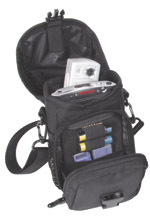 Everyone
has different needs ÷ itās why youāll find so many shapes and sizes
of camera cases. The pro headed to cover a wedding or the World
Series is going to have a different set of needs than the casual
shooter taking a camera and a spare lens out for a walk through
the local botanical gardens.
Everyone
has different needs ÷ itās why youāll find so many shapes and sizes
of camera cases. The pro headed to cover a wedding or the World
Series is going to have a different set of needs than the casual
shooter taking a camera and a spare lens out for a walk through
the local botanical gardens. 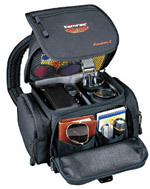 Ideally,
I want a case that will protect my gear, but also can be painlessly
consolidated into something of another bag. For example, if Iām
traveling, I donāt want a dedicated camera case; I want something
that can hold an extra sweater, a rain hat, water bottle, and guide
book ÷ and, oh yes, that camera and assorted lenses, too. Whether
the bag itself is designed to accommodate all of the above, or I
find cases for the camera(s) and lenses that are small enough to
fit into another, generic knapsack ÷ well, either scenario would
work for me.
Ideally,
I want a case that will protect my gear, but also can be painlessly
consolidated into something of another bag. For example, if Iām
traveling, I donāt want a dedicated camera case; I want something
that can hold an extra sweater, a rain hat, water bottle, and guide
book ÷ and, oh yes, that camera and assorted lenses, too. Whether
the bag itself is designed to accommodate all of the above, or I
find cases for the camera(s) and lenses that are small enough to
fit into another, generic knapsack ÷ well, either scenario would
work for me. 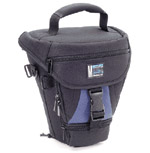 canāt say Iāve seen every case out there, but of those Iāve seen,
none has really impressed me. Instead, the pouch Iāve settled isnāt
even a camera case, per se: I found it in a luggage store while
wandering in Prague, and instantly realized it was perfectly suited.
Itās a small, horizontal access shoulder bag, with a soft, lightly
padded pouch that fits comfortably under a coat, or even alongside
a larger backpack. The pouch is such that I can keep the camera
inside it and yank it out as needed; or, I can swap the point-and-shoot
digicam for a compact SLR lens, and use the pouch to provide me
with easy-access to my lens.
canāt say Iāve seen every case out there, but of those Iāve seen,
none has really impressed me. Instead, the pouch Iāve settled isnāt
even a camera case, per se: I found it in a luggage store while
wandering in Prague, and instantly realized it was perfectly suited.
Itās a small, horizontal access shoulder bag, with a soft, lightly
padded pouch that fits comfortably under a coat, or even alongside
a larger backpack. The pouch is such that I can keep the camera
inside it and yank it out as needed; or, I can swap the point-and-shoot
digicam for a compact SLR lens, and use the pouch to provide me
with easy-access to my lens. 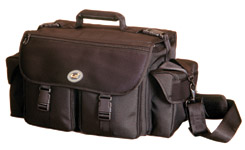 Sadly,
these cases are virtually non-existent today; and many of the soft-sided
cases Iāve seen, such as Nikonās for the D70, are ineffectual. The
closest Iāve found in this regard is a neoprene case made by Hakuba
(and sold in Japan); the D70 case I bought there is a single piece,
with a base that protects the cameraās body, and a flip-up lid that
closes in back ÷ a much more efficient and effective approach than
one of the attempts at a neoprene case I recently noticed in a local
camera store.
Sadly,
these cases are virtually non-existent today; and many of the soft-sided
cases Iāve seen, such as Nikonās for the D70, are ineffectual. The
closest Iāve found in this regard is a neoprene case made by Hakuba
(and sold in Japan); the D70 case I bought there is a single piece,
with a base that protects the cameraās body, and a flip-up lid that
closes in back ÷ a much more efficient and effective approach than
one of the attempts at a neoprene case I recently noticed in a local
camera store. 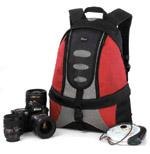 Loweproās
Orion Trekker II is the closest Iāve found yet to a multipurpose
daypack that doesnāt scream out ćThis is my camera bag!ä The bag
is a big, full-size backpack, and it has two connected sections;
the top flips over to reveal the zippered, segmented compartment
beneath. The top section can accommodate lunch, supplies, trinkets,
or maps ÷ you could even fit a compact DSLR up there (my Nikon D70
fit fine). The bottom is fully adjustable, so you can play with
the lens and body fittings as needed.
Loweproās
Orion Trekker II is the closest Iāve found yet to a multipurpose
daypack that doesnāt scream out ćThis is my camera bag!ä The bag
is a big, full-size backpack, and it has two connected sections;
the top flips over to reveal the zippered, segmented compartment
beneath. The top section can accommodate lunch, supplies, trinkets,
or maps ÷ you could even fit a compact DSLR up there (my Nikon D70
fit fine). The bottom is fully adjustable, so you can play with
the lens and body fittings as needed.