|
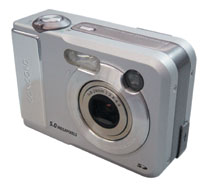
Concord Eye-Q 5345z
Inexpensive enough to appeal?
(by Conrad H. Blickenstorfer)
 Unlike
the likes of Canon, Olympus, Nikon and other traditional imaging
companies which generally are involved in a variety of fields, the
Concord Camera Corporation has just one goal, and that is to make
and sell inexpensive digital and other cameras. They are the world
leader in single use cameras and sells dozens of millions of cameras
every year, both under their own name and for others, including
some big name brands. Unlike
the likes of Canon, Olympus, Nikon and other traditional imaging
companies which generally are involved in a variety of fields, the
Concord Camera Corporation has just one goal, and that is to make
and sell inexpensive digital and other cameras. They are the world
leader in single use cameras and sells dozens of millions of cameras
every year, both under their own name and for others, including
some big name brands.
In
the digital space, Concord currently offers no less than 14 different
cameras ranging from the minimalist Eye-Q Mini VGA camera all the
way up to the flagship 5-megapixel 5345z that has been available
since April of 2004 and generally goes for around $299. What exactly
do you get with the Concord, and why would you want to pick one
over one of the more prestigious "name brand" cameras?
For
starters, the aluminum-clad 5345z looks anything but cheap. In fact,
it looks and feels like it is crafted entirely from a solid block
of magnesium or titanium. Design and execution are first rate and
much better than what you'd expect from a low cost camera manufacturer.
Every line, curve, and detail is just right, and the fine matte
silver power finish is perfect. The camera is also smaller than
it looks in pictures -- just 3.5 x 2.4 x 1.25 inches -- and it weighs
under six ounces. No one would be surprised if "Canon" or ćMinoltaä
were embossed on its front instead of "Concord."
A closer
look reveals lots of very well thought-out details. The two ports
(USB and power) are protected by rubbery little flaps attached to
the camera so you wonāt lose them. There is a minimum of controls,
yet they do everything you need in a point & shoot, and they are
clearly marked. There are two buttons for taking and viewing pictures,
and a five-way navigation disc that also controls macro and flash.
The navigation disc is flanked by a menu and a display button. One
control that takes a bit of getting used to is the zoom. Instead
of a rocker operated by your thumb, the Concord uses the ring around
the shutter for zoom control. This means that your index finger
can either depress the shutter or operate the zoom, but not both.
Push
a small recessed button on top of the camera and the Concord starts
up almost instantly, shooting out its zoom lens barrel as if it
were spring loaded. Unfortunately, there is long waiting between
shots and while the manual lists a burst mode, we couldnāt find
it.
Despite
having only 85k pixels, the 1.6-inch LCD display is sharp and crisp.
When in use, pushing the "disp" button cycles through LCD on and
off, LCD on with info, and LCD on with info and a histogram graph
that will quickly tell you whether you end up with a dark, bright
or well balanced image. Very handy.
The
Concordās on-screen menus are as simple and elegant as the camera
itself. The system uses three tabbed folders for recording options,
memory options, and setup. All menus are transparent and all menu
options are in plain English and have walking menus where needed.
Things like white balance, filters, or exposure compensation actually
open up a little live window so you can see what selecting a setting
will look like. There are no less than 19 scene modes. Each one
of them is explained by a cute color image and a description of
what the mode does. In "Pet" mode, for example, the camera shows
you a stylized dog and explains: "High sensitivity. Shoot from the
eye level of your pet."
You
canāt select between shutter or aperture priority and such, but
the Concordās menus give you a lot of control over auto focus, metering,
white balance, sharpening, saturation, filters, image size and quality,
contrast, flash intensity and more. This is a point & shooter that
also lets you fiddle with settings to your heart's content.
The
Concord comes with 9.7 megabyte of internal storage and you can
also use a SD card (none is included). The card is located next
to the batteries which have no retainer to keep them in place, so
make sure they donāt fall out when you insert or remove a memory
card. On the plus side, the Concord comes with a charger that can
handle any rechargeable AA batteries.
Model-Concord 5345z
List price-US$379
Sensor res-5.0 megapixels
Image dimensions-2560x1920 down
to 640x480
ISO-Auto, 50/100/200/400
Lens-F:2.8-8.4
Lens focal length-8-24 mm (39-117mm
equiv.)
Shutter-1/2000 to 1/8 seconds
Exposure compensation-+/2EV in 1/3
steps
Storage-SD/MMC plus 9MB internal
Focus-Phase/contrast: spot, manual
LCD screen-2.0 inch TFT (115k)
Flash modes-4 modes
I/O-USB
Battery-2 AA rechargeable
Weight-5.8 ounces w/o battery
Dimensions-3.375 x 2.375 x 1.25
inches
Included-MGI PhotoSuite and VideoWave,
cable |
Video
clip fans may be disappointed that Concordās top of the line camera
can only do up to 60 seconds worth of 320 x 240 clips and sound
only plays back once the clip is on a PC.
Picture
quality is quite good. 5 megapixel resolution means you can take
2560 x 1920 pixel pictures in three different levels of compression.
Thatās good enough for 8 x 10 prints or even larger. A macro setting
lets you get as close as four inches, the flash is strong, and there
is a 4X digital zoom on top of the very quick 3X optical zoom. The
display washes out outdoors so youāll have to rely on the optical
viewfinder.
On
the software side you get MGI PhotoSuite and MGI VideoWave, both
good applications. Unfortunately, there is nothing for Mac users.
Ultimately,
however, the Concord's classy looks promise more than it delivers.
It's an elegant little camera and we appreciate the design, the
picture quality, all those scene modes, the ease of operation, the
nice menus, but things like the limited movie option and the very
slow recycle time mean the camera will be mostly judged on its low
price, and even that doesn't seem that low anymore.
-- Conrad
Blickenstorfer
|